
The link between 5S and TPM
5S organizes the environment. TPM keeps the equipment running. The two meet at one point: the operator. When the operator cleans the machine methodically, 5S becomes the first level of autonomous maintenance.
Without this link, 5S stays cosmetic and TPM stays in the maintenance shop. With it, organization reveals failures before they stop production. The foundational concepts are in 5S step by step and TPM. The six tips below make the connection.
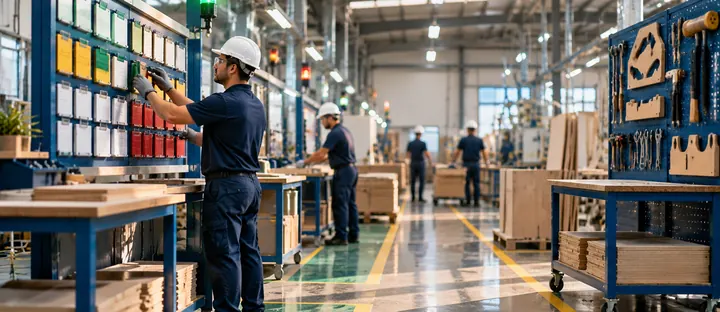
Think of the two methodologies as stages of a single routine. First you sort and clean (seiri, seiton, seiso). Then you standardize and sustain (seiketsu, shitsuke). TPM gives each stage a technical purpose: clean to find failures, organize to make inspection easier, standardize so that every shift does it the same way.
Tip 1: cleaning is inspection
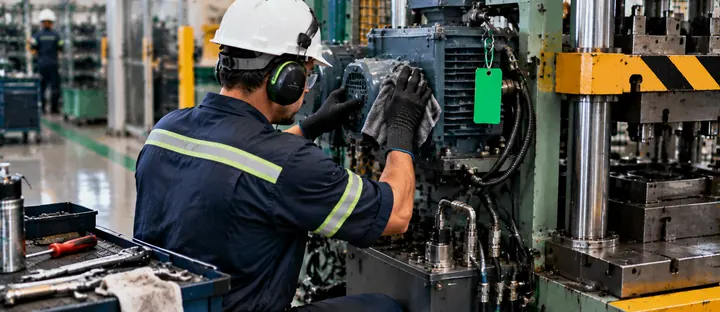
Whoever cleans a machine touches every part of it. That contact is where leaks, loose bolts, play, noise, and vibration show up. Train the operator to look while cleaning and to write down what was found.
Create a simple rule: every anomaly becomes a tag on the equipment, with a date and a description. That way cleaning stops being housekeeping and becomes information gathering.
Use a different tag color for each type of anomaly: one color for what the operator fixes personally and another for what requires maintenance. At the end of the week, count the open and closed tags. The number of tags the operator closes alone shows progress toward autonomy, and the tags that stay open for a long time show where maintenance needs to respond better.
Tip 2: lubrication tags and control points
Lubrication without identification causes two errors: forgetting the point or using the wrong product. Mark each point with the lubricant's color and code, and show the type, frequency, and responsible person at the point.
Do the same with pressure gauges and sight glasses: mark the normal range. The operator notices a deviation without consulting a manual. It is visual management applied to the machine, as in visual management on the shop floor.
Also record where the lubrication tools are kept, on a cart identified with the same colors as the points. That way the right lubricant reaches the right point, and the risk of cross-contamination drops. If lubrication is done by another team, agree on the schedule so the operator knows when the point was serviced.
Tip 3: attack the hard-to-reach spots
Dirt starts at sources (leaks, chips, dust) and accumulates in hard-to-reach places. If cleaning is too costly, nobody cleans. Two actions solve this:
- Eliminate or contain the source of dirt, with a guard, chute, or collector.
- Make access easier: a hinged cover, a transparent cover, a panel that can be removed without tools.
This is an engineering improvement in service of 5S. Each point made easier to reach reduces cleaning time and the chance of skipping the task.
Prioritize by frequency and risk. A point that collects dirt every day and sits near a bearing deserves action before a point that is cleaned once a week. Ask the operator for ideas: they know where cleaning hurts.
Tip 4: standardize cleaning
A cleaning and inspection standard states what, where, how, with which tool, in how much time, and how often. Keep it on one sheet per piece of equipment, with a photo of the point. Follow the logic of standardized work.
| Standard item | Example |
|---|---|
| What | Conveyor guide and position sensor |
| How | Dry cloth, then low-pressure compressed air |
| Frequency | Start of each shift |
| Time | Five minutes |
| Anomaly | Tag it and notify the supervisor |
The time allowed in the standard has to fit within the workday, otherwise the task will be cut at the first rush.
Tip 5: audit with a focus on the machine
The usual 5S audit looks at order and cleanliness. Add TPM questions: does the open tag have a deadline? Is the lubrication point identified? Is the cleaning standard in place and up to date? Can the operator explain the last anomaly?
Audit in pairs, with a supervisor and an operator from another area. Record the score by zone and open an action for each failure, in the 5W2H format.
Compare audit scores with equipment performance. If the score goes up and the number of minor stops does not fall, the standard may be taking care of appearance rather than the condition of the machine. Adjust the checklist to look at what actually causes failures.
Tip 6: give the operator responsibility
Autonomous maintenance means the operator takes care of the basic conditions: cleaning, lubricating, tightening, and inspecting. The maintenance team handles what requires specialist skills and trains the operator to do more.
For this to work, three conditions apply: training in the standards, time set aside in the workday, and a quick response when the operator reports an anomaly. Without a response, the operator stops reporting. The effects show up in indicators such as MTBF and MTTR.
Next step
Choose a critical piece of equipment. Do an initial cleaning with the operator, tag every anomaly, and record what was found. Define the cleaning and inspection standard and track for four weeks how many anomalies were found and corrected by the team itself.
Then replicate the model on the other equipment in the area.
Also record the time spent cleaning and the number of items found. These two data points justify the time set aside in the workday and show management the return on the practice.
Frequently asked questions
What is the relationship between 5S and TPM?
5S creates the organized, clean environment, and inspection-by-cleaning becomes the first step of autonomous maintenance, one of the pillars of TPM.
What is autonomous maintenance?
It is the practice in which the operator takes care of the equipment's basic conditions: cleaning, lubrication, tightening, and inspection, following defined standards.
Why do people say that cleaning is inspection?
Because when cleaning, the operator touches and observes every part of the machine, and so finds leaks, play, and noises early.
How do I keep 5S from losing momentum?
With written standards, time in the workday, periodic audits, and a quick response to reported anomalies.
Who should clean the machine?
The operator, trained and with time set aside. Maintenance supports and handles what requires specialist skills.
Keep studying
Sources
- Lean Enterprise Institute. Five S (glossary). https://www.lean.org/lexicon-terms/five-s/
- Lean Enterprise Institute. Total Productive Maintenance (glossary). https://www.lean.org/lexicon-terms/total-productive-maintenance/
- LIKER, J. O Modelo Toyota. Porto Alegre: Bookman.
Want to implement 5S without losing momentum?
Download the free 5S in Practice e-book, with checklists and an audit template for the shop floor.
Download the e-book
About the author
Lean Manufacturing & Behavioral Management Specialist
Over 20 years in the automotive and metalworking industries (GM and Dana), Lean Manufacturing practitioner since 2006. SENAI instructor and mentor in Brazil’s Brasil Mais Produtivo program, delivering consulting, training and audits for 50+ companies, combining quality, productivity and people development.