What RCM is
Reliability centered maintenance (RCM) is a structured method for deciding, asset by asset, which maintenance is actually worth doing. It starts from the function the asset must perform and answers 7 questions to pick the right task for each failure mode.
The method grew out of US commercial aviation in the 1970s and was consolidated in Nowlan and Heap's 1978 book (United Airlines). The central idea: maintenance is not about restoring equipment to like-new condition but about preserving function. Many failures are not age-related, so replacing parts on a calendar does not always help.
It complements TPM: TPM engages operations and eliminates losses; RCM defines the maintenance strategy per asset and per failure consequence.
RCM visual map
The map shows the 7 questions, the decision tree and the pump example with its P-F interval.

The 7 RCM questions
| # | Question | Output |
|---|---|---|
| 1 | What are the functions and performance standards of the asset in its present operating context? | Primary and secondary functions with measurable values |
| 2 | In what ways can it fail to fulfill those functions? | Functional failures (total or partial) |
| 3 | What causes each functional failure? | Failure modes |
| 4 | What happens when each failure occurs? | Failure effects |
| 5 | In what way does each failure matter? | Consequences: safety, environment, operational, non-operational, hidden |
| 6 | What can be done to prevent or predict each failure? | Proactive tasks and intervals |
| 7 | What if no suitable proactive task can be found? | Default action: failure finding, redesign or run to failure |
Questions 3 and 4 are what FMEA does. The difference is that RCM does not stop at a risk score: questions 5 to 7 decide the maintenance task.
Example: cooling water centrifugal pump
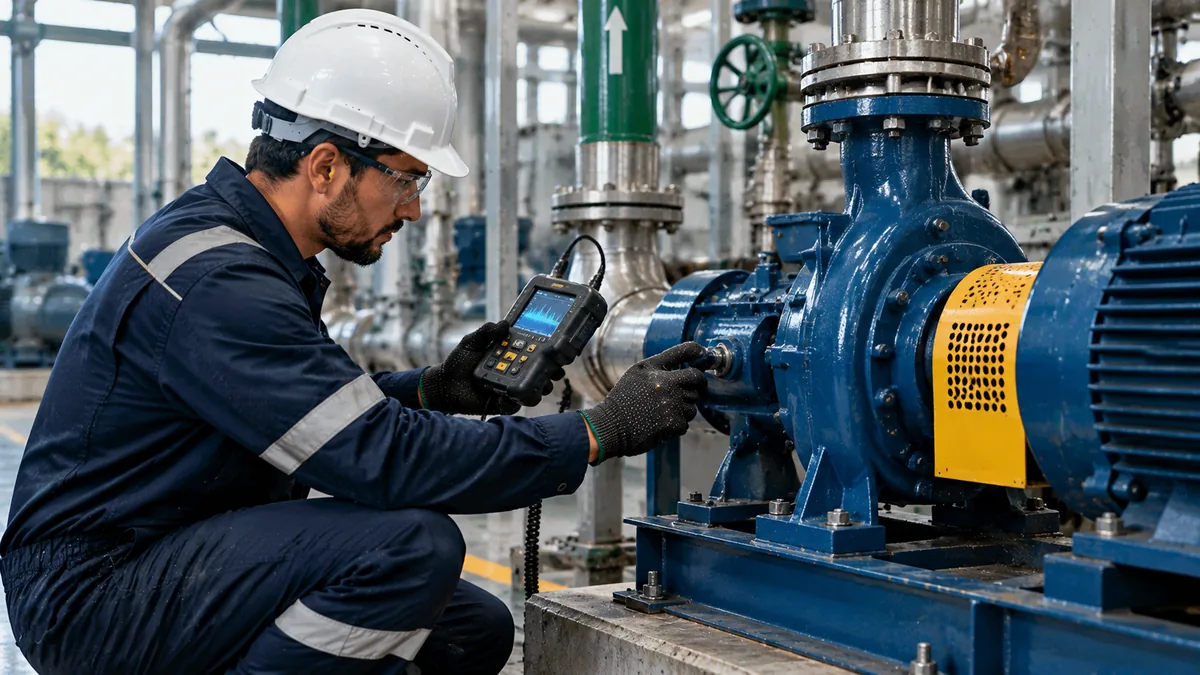
Illustrative example (not a real case). The pump feeds the cooling of a press and must deliver 120 m³/h at 4 bar.
| Question | Example answer |
|---|---|
| 1. Function | Deliver 120 m³/h at 4 bar |
| 2. Functional failure | A) Delivers no flow; B) delivers less than 100 m³/h |
| 3. Failure mode | A) Seized bearing; B) worn impeller |
| 4. Effect | A) Temperature alarm, press stops in about 10 min; B) temperature rises slowly |
| 5. Consequence | A) Operational (lost production); B) operational |
| 6. Task | A) Monitor vibration (on-condition); B) measure flow and pressure (on-condition) |
| 7. Default | If inspection were not feasible: standby pump and periodic test |
Consequence and decision tree
Question 5 classifies each failure. It is the consequence, not the failure mode, that sets how much effort is justified.
- Hidden: failure of a protective function (relief valve, alarm) that only shows when another failure occurs. Calls for failure finding (functional test).
- Safety and environment: requires a task that reduces risk to a tolerable level; if none exists, redesign is mandatory.
- Operational: the task is worth it only if it costs less than the lost production plus repair.
- Non-operational: worth it if it costs less than the repair.
| Proactive task | When it is feasible |
|---|---|
| On-condition (predictive) | The failure gives a warning and there is a useful P-F interval |
| Scheduled restoration | There is an age at which failure probability rises and almost all items reach it |
| Scheduled discard | Same condition, for a part that cannot be restored |
| Failure finding | Hidden function; not valid for an evident failure |
| Redesign | No task reduces the risk; the asset or process changes |
| Run to failure | Small consequence and prevention costs more than repair |
P-F interval and task interval calculation
In condition-based maintenance, point P is when a potential failure can be detected and point F is when it becomes a functional failure. The time between them is the P-F interval. Inspection must occur at a shorter interval.
Inspection interval ≈ P-F ÷ 2
In the example, the bearing shows rising vibration and fails on average 6 weeks later. Inspecting every 6 ÷ 2 = 3 weeks guarantees at least one reading and leaves at least 3 weeks to plan the replacement.
Availability before and after (hypothetical values): before, MTBF of 1,200 h and MTTR of 8 h, A = 1,200 ÷ (1,200 + 8) = 99.34%. After, with planned replacement, MTBF of 2,400 h and MTTR of 4 h, A = 2,400 ÷ 2,404 = 99.83%. See how to calculate them in MTBF and MTTR.
Failure finding for hidden functions
For a protective device, mean unavailability is approximately the test interval divided by 2 times the device MTBF.
Unavailability ≈ test interval ÷ (2 × device MTBF)
Example: a standby pump with an MTBF of 260 weeks, tested every 4 weeks. Unavailability = 4 ÷ (2 × 260) = 0.77%, or availability of 99.23%. If the target requires 99.5%, the test must be every 2.6 weeks, since 2.6 ÷ 520 = 0.5%.
How to implement RCM
- Choose assets by criticality (impact on safety, quality and production). Start with a few, because the method is labor-intensive.
- Form a team of 4 to 6 people: operator, maintainer, engineering and a facilitator who knows the method.
- Answer the 7 questions and record them in a spreadsheet or software, asset by asset.
- Turn the decisions into a plan: tasks, intervals, owners, spare parts and procedures.
- Execute, measure and review. Track failures, MTBF, OEE and cost. OEE shows whether availability improved.
Simple inspection and lubrication tasks can be done by operators, as in autonomous maintenance. To investigate recurring failures, use the 5 Whys.
Common mistakes
- Applying it to every asset. For low-criticality equipment, run to failure can be the best decision.
- Starting from failure modes without first defining the function and performance standard.
- Listing failures by guesswork without history data and without listening to operators.
- Replacing parts on a calendar when failure is not age-related: it raises cost and can introduce infant mortality.
- Forgetting hidden protective functions, which nobody notices until the day of the accident.
- Doing the study and never implementing or reviewing the plan.
Frequently asked questions
What is RCM in maintenance?
Reliability centered maintenance: a method that defines, per asset, the most suitable maintenance task based on its function and the consequences of each failure.
What are the 7 RCM questions?
Functions and standards, functional failures, failure modes, effects, consequences, proactive tasks, and the default action when no suitable task exists.
What is the difference between RCM and TPM?
TPM involves operations and eliminates losses. RCM defines the maintenance strategy of each asset. They complement each other.
What is the difference between RCM and FMEA?
FMEA identifies failure modes, effects and risk. RCM goes further and chooses the maintenance task according to the consequence.
What is the P-F interval?
The time between detecting a potential failure (point P) and the functional failure (point F). Inspect at about half of it.
Does RCM suit every piece of equipment?
It can, but it pays off on critical assets. For low-criticality items use a simplified version or run to failure.
Sources
- NOWLAN, F. S.; HEAP, H. F. Reliability-Centered Maintenance. United Airlines / U.S. Department of Defense, 1978.
- MOUBRAY, J. Reliability-Centered Maintenance (RCM II). 2nd ed. New York: Industrial Press, 1997.
- SAE INTERNATIONAL. SAE JA1011: Evaluation Criteria for Reliability-Centered Maintenance (RCM) Processes.
- SMITH, A. M.; HINCHCLIFFE, G. R. RCM: Gateway to World Class Maintenance. Butterworth-Heinemann.
Keep studying: trusted sources and links
- NIST e-Handbook: Assessing Product Reliability
- ABRAMAN: Associação Brasileira de Manutenção e Gestão de Ativos (in Portuguese)
- Wikipedia: Reliability engineering
- Wikipedia: Maintenance
Save this address: Manufatura Enxuta is your school for lean manufacturing. Come back whenever you need to study, with a complete article, a visual map and trusted sources. Follow one of the learning paths or check the A–Z glossary.
Want to measure what really matters?
Download the free e-book on performance indicators and track the losses in your operation.
Download the e-book
About the author
Lean Manufacturing & Behavioral Management Specialist
Over 20 years in the automotive and metalworking industries (GM and Dana), Lean Manufacturing practitioner since 2006. SENAI instructor and mentor in Brazil’s Brasil Mais Produtivo program, delivering consulting, training and audits for 50+ companies, combining quality, productivity and people development.