

What an 8D report is
An 8D report is a structured problem-solving method in eight disciplines (D1 to D8), used for customer complaints and recurring failures: it contains the problem, protects the customer, finds the root cause and stops recurrence. It is common across the automotive supply chain, where customers require the 8D from the supplier.
The method comes from Ford, which published the guide "Team Oriented Problem Solving" in the 1980s with eight disciplines; many companies later added a D0 step for preparation and emergency response. The core principle: contain first, investigate second, correct permanently and standardize.
8D visual map of the eight disciplines
The map shows disciplines D1 to D8 on a timeline, the tools for each and the numeric example below.
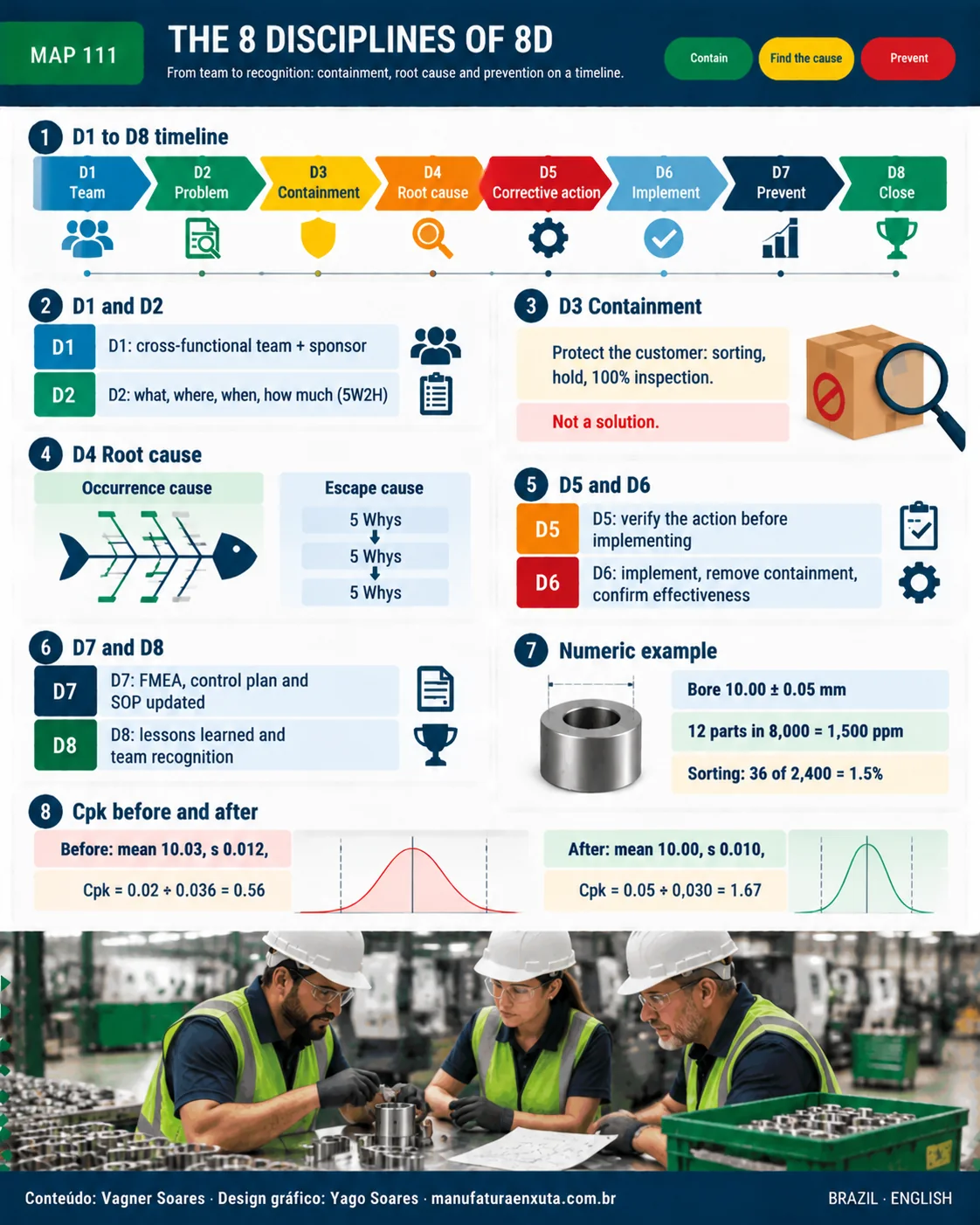
The eight disciplines, one by one
| Discipline | Goal | Tools |
|---|---|---|
| D1 Team | Gather people who know the process, a leader and a sponsor | Skills matrix |
| D2 Describe the problem | State what, where, when and how much, with data | 5W2H, is / is not |
| D3 Interim containment | Protect the customer until the permanent fix | Sorting, stock hold, 100% inspection |
| D4 Root cause | Find the occurrence cause and the escape cause (why it was not detected) | Fishbone, 5 Whys |
| D5 Corrective actions | Choose and verify the permanent action before implementing | Pilot run, Cpk |
| D6 Implement and validate | Implement, remove containment and confirm effectiveness | Follow-up data |
| D7 Prevent recurrence | Update standards and extend to similar processes | FMEA, control plan, SOP |
| D8 Close and recognize | Approve closure, record lessons learned, recognize the team | Lessons-learned database |
Two points separate a good 8D from a paper exercise: containment in D3 does not replace the permanent action, and D4 must also explain why the defect escaped detection.
Worked example: bore out of tolerance
Fictional case: a supplier of machined bushings receives a customer complaint. Of 8,000 parts delivered, 12 arrived with a bore above the upper limit. The specified bore is 10.00 ± 0.05 mm (9.95 to 10.05 mm).
| Step | Record |
|---|---|
| D1 | Quality lead, lathe operator, maintenance, engineering; sponsor: plant manager |
| D2 | 12 parts in 8,000 with bore > 10.05 mm: 12 ÷ 8,000 × 1,000,000 = 1,500 ppm |
| D3 | Sorting of 2,400 parts in stock: 36 rejected, or 36 ÷ 2,400 = 1.5%; 100% inspection with a go/no-go gauge until the permanent action |
| D4 | Occurrence cause: worn drill, no tool-life control. Escape cause: final sampling inspection of 5 parts per lot did not detect it |
| D5 | Drill change by hole counter and SPC on the diameter |
| D6 | Implemented on the line, result checked for 3 months with no nonconforming part |
| D7 | FMEA, control plan and SOP updated; counter extended to other machines |
| D8 | Closure approved, lessons recorded |
Verification in D5 uses process capability, with Cpk = min(USL − mean; mean − LSL) ÷ 3s.
| Situation | Mean | Standard deviation (s) | Cpk |
|---|---|---|---|
| Before | 10.03 mm | 0.012 mm | min(10.05 − 10.03; 10.03 − 9.95) ÷ (3 × 0.012) = 0.02 ÷ 0.036 = 0.56 |
| After | 10.00 mm | 0.010 mm | min(0.05; 0.05) ÷ 0.030 = 1.67 |
Before the action, the process was off-center and unstable (a Cpk of 0.56 is far below the usual minimum of 1.33); afterwards, it was centered and capable.
How to write and run a good 8D
- Open within 24 hours: do the containment (D3) before the deep investigation.
- Describe with data: use counts, photos, lot, date and location. Avoid "bad parts".
- Validate the measurement system before concluding the part is out (MSA).
- Test the root cause: reproduce the defect by switching the cause on and off. Without proof, it is a hypothesis.
- Verify the action before implementing and confirm effectiveness afterwards (D6).
- Close with standardization: an 8D without D7 will happen again.
If the company already uses the A3 report, the 8D fits customer complaints and containment better; the A3 suits internal problems and improvement. For nonconformity handling in general, see nonconformity and CAPA; for the document that receives the D7 actions, see the control plan.
Common mistakes
- Stopping the 5 Whys at the first answer and blaming the operator.
- Treating containment (D3) as the solution.
- Ignoring the escape cause: the defect moved on because the control failed.
- Closing without measuring effectiveness over a defined period.
- Not updating FMEA, control plan and SOP.
- Building a team without anyone who knows the process.
- Filling in the customer form without investigating.
Frequently asked questions
What does 8D mean?
The eight disciplines (D1 to D8) of a structured problem-solving method, from forming the team to recognizing the team.
What is the difference between 8D and A3?
The 8D focuses on customer complaints and containment, in a stricter format; the A3 is a one-page report used for internal problems and improvements.
What is D0 in 8D?
A preparation step used by many companies that assesses whether an 8D is needed and triggers the emergency response.
What is the deadline for an 8D report?
It depends on the customer. Containment within 24 hours is common, with the full report due on a contractually defined date.
What is the difference between occurrence cause and escape cause?
The occurrence cause explains why the defect was created; the escape cause, why the control did not detect it.
Who should lead an 8D?
Someone with authority and process knowledge, backed by a sponsor who releases resources.
Sources
- FORD MOTOR COMPANY. Team Oriented Problem Solving (TOPS), 1980s.
- LIKER, J. K. The Toyota Way: 14 Management Principles. McGraw-Hill.
- MONTGOMERY, D. C. Introduction to Statistical Quality Control. Wiley.
- ISO 9001: Quality management systems, requirements on nonconformity and corrective action.
Keep studying: trusted sources and links
Save this address: Manufatura Enxuta is your school for lean manufacturing. Come back whenever you need to study, with a complete article, a visual map and trusted sources. Follow one of the learning paths or check the A–Z glossary.
Want the tools ready to use?
Download the free "Problem Solving Kit" e-book, with PDCA, A3, 5 Whys and Ishikawa.
Download the e-book
About the author
Lean Manufacturing & Behavioral Management Specialist
Over 20 years in the automotive and metalworking industries (GM and Dana), Lean Manufacturing practitioner since 2006. SENAI instructor and mentor in Brazil’s Brasil Mais Produtivo program, delivering consulting, training and audits for 50+ companies, combining quality, productivity and people development.