
What is a skills matrix
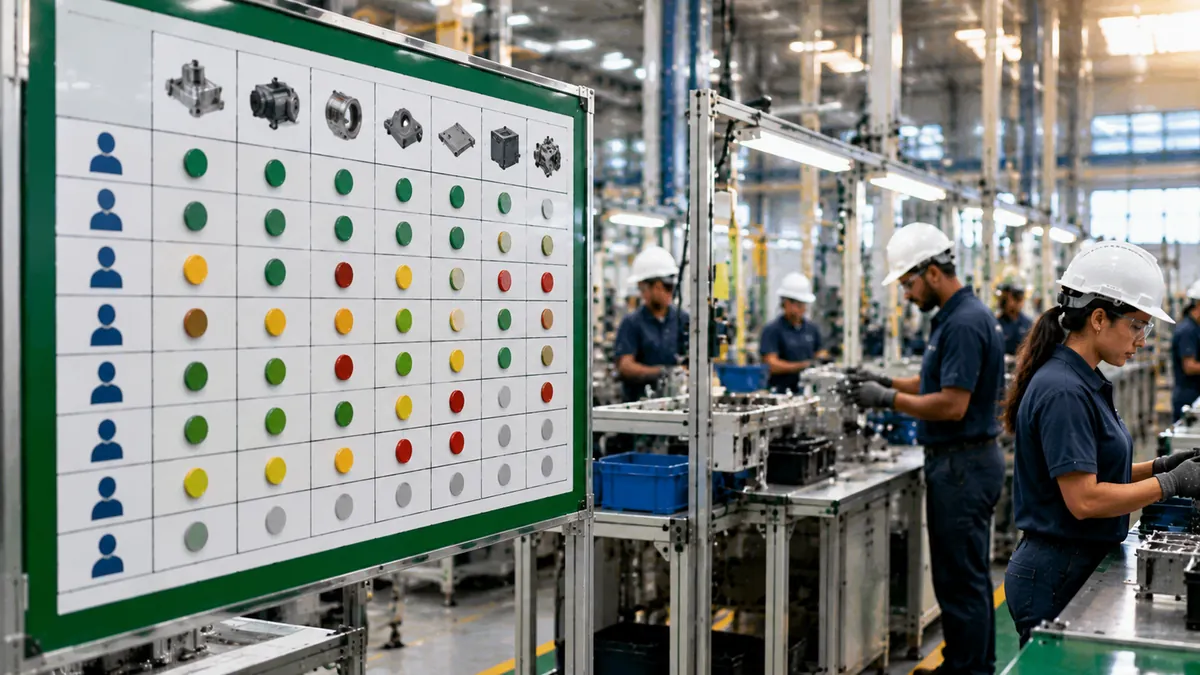
A skills matrix (also called a cross-training or polyvalence matrix) is a table that crosses people and workstations and shows each person's level at each station. It answers three questions: who can do what, which stations depend on a single person, and who needs training on what.
It is the tool that connects TWI training to daily work: without a record, nobody knows how much of the team can really cover an absence, a demand peak or a shift change.
Skills matrix visual map
The map shows the five levels, the example matrix, the coverage formulas and the training plan.

Skill levels (0 to 4)
Use one short scale for the whole plant. Five levels are enough, as long as each has an observable criterion and not an opinion.
| Level | Meaning | Observable criterion |
|---|---|---|
| 0 | Does not know the station | Has never worked on it |
| 1 | In training | Knows the operation, performs only with full supervision |
| 2 | Performs with support | Does the operation but still needs help or falls short of standard time and quality |
| 3 | Independent | Performs to standard time and quality, without support, following standard work |
| 4 | Trainer | Masters the station, handles abnormalities and can teach others |
Only levels 3 and 4 count as qualified to cover a station. Level 4 should exist at every critical station, because that is where the next trainer comes from.
Example: 5 operators and 6 stations
Fictional example of a cell, with a target of at least 2 qualified people (level ≥ 3) per station.
| Operator | Cutting | Press | Welding | Assembly | Test | Packing | Stations ≥ 3 |
|---|---|---|---|---|---|---|---|
| A | 4 | 3 | 0 | 2 | 0 | 3 | 3 |
| B | 0 | 4 | 2 | 3 | 1 | 0 | 2 |
| C | 2 | 0 | 4 | 1 | 0 | 0 | 1 |
| D | 3 | 0 | 0 | 4 | 3 | 2 | 3 |
| E | 0 | 2 | 1 | 0 | 4 | 2 | 1 |
| Qualified (≥ 3) | 2 | 2 | 1 | 2 | 2 | 1 | — |
Quick read: Welding has only one qualified person (C), and so does Packing (A). If C is absent, welding stops. Those two stations are the cell's risk.
How to calculate coverage and polyvalence
Station coverage = qualified ÷ target (max. 100%)
Person polyvalence = stations at level ≥ 3 ÷ total stations
- Cell coverage: each station counts at most 2 (the target). Cutting, Press, Assembly and Test have 2; Welding and Packing have 1. Sum = 2+2+1+2+2+1 = 10, divided by 6 × 2 = 12, gives 83.3%.
- Polyvalence per person: A and D have 3 of 6 stations (50%); B has 2 (33.3%); C and E have 1 (16.7%). The average is 10 ÷ 30 = 33.3%.
- Matrix fill rate: sum of all levels (50) ÷ maximum possible (5 × 6 × 4 = 120) = 41.7%.
The three numbers serve different purposes. Coverage measures risk today, polyvalence measures each person's flexibility and the fill rate shows the total room to grow.
From gap to training plan
The plan comes from the stations below target. Choose who to train by how close they are to level 3 and by their current low polyvalence.
| Station | Gap | Who to train | Progression | Estimated effort (example) |
|---|---|---|---|---|
| Welding | 1 qualified person short | B | level 2 to 3 | 24 h on-the-job training |
| Packing | 1 qualified person short | E | level 2 to 3 | 16 h on-the-job training |
| Packing (trainer) | no level 4 | A | level 3 to 4 | practice teaching, afterwards |
With B on Welding and E on Packing, both stations reach 2 qualified people: cell coverage goes to 12 ÷ 12 = 100% and average polyvalence rises to 12 ÷ 30 = 40%. The effort of 24 h + 16 h = 40 h is an estimate for the example; use your own real training time per level.
Teach with the JI method and record the date of each level change. TWI itself sets the rule: the learner moves up a level only when they perform alone, to standard.
How to build your matrix
- List the stations of the cell or line in flow order. If there are too many operations, group very similar ones.
- Define the criteria for levels 0 to 4, with expected time and quality.
- Assess by observation, with the leader and, if possible, the operator. Do not rely on self-assessment alone.
- Set the coverage target per station: 2 for ordinary stations; more for bottlenecks or high-turnover stations.
- Calculate the gaps and choose who to train, on what and by when.
- Display the matrix on the area board using visual management and update it at least monthly.
The matrix also feeds manpower sizing and line balancing: without polyvalence there is no way to reassign operators when takt changes. For the effect of absences, see also absenteeism and turnover.
Common mistakes
- Building the matrix once and never updating it. An outdated matrix misleads more than it helps.
- Giving level 3 out of sympathy or seniority, without observing time and quality.
- Having a critical station with a single qualified person and doing nothing about it.
- Wanting everyone on every station. Full polyvalence is expensive; set the target per station.
- Training without recording. If the date and level do not reach the matrix, the training does not exist for planning.
- Using the matrix as a punishment tool. It exists to plan training.
Frequently asked questions
What is a skills matrix?
A table crossing people and stations that shows each person's level at each station. It is used to plan coverage and training.
Is a skills matrix the same as a cross-training matrix?
In practice yes. Cross-training is the ability of a person to work at several stations, and the matrix is where it is recorded.
How many levels should I use?
Five (0 to 4) are usually enough. What matters is that each level has an observable criterion.
How do you calculate station coverage?
Divide the number of qualified people (level 3 or 4) by the station target, capped at 100%. In the example, Welding had 1 of 2, or 50%.
What is a good target of qualified people per station?
Generally at least 2, so one absence does not stop the station. Bottleneck or high-turnover stations call for more.
How often should the matrix be updated?
At least monthly, and whenever someone changes level, is hired or leaves the area.
Sources
- DINERO, D. Training Within Industry: The Foundation of Lean. New York: Productivity Press, 2005.
- GRAUPP, P.; WRONA, R. J. The TWI Workbook: Essential Skills for Supervisors. New York: Productivity Press, 2006.
- LIKER, J. K.; MEIER, D. The Toyota Way Fieldbook. New York: McGraw-Hill, 2006.
- SLACK, N.; BRANDON-JONES, A.; JOHNSTON, R. Operations Management. Harlow: Pearson.
Keep studying: trusted sources and links
- ABEPRO: Associação Brasileira de Engenharia de Produção (in Portuguese)
- Wikipedia: Lean manufacturing
Save this address: Manufatura Enxuta is your school for lean manufacturing. Come back whenever you need to study, with a complete article, a visual map and trusted sources. Follow one of the learning paths or check the A–Z glossary.
Want a quick reference guide for the factory floor?
Download the free Pocket Guide e-book with the Lean tools summarized on one page each.
Download the e-book
About the author
Lean Manufacturing & Behavioral Management Specialist
Over 20 years in the automotive and metalworking industries (GM and Dana), Lean Manufacturing practitioner since 2006. SENAI instructor and mentor in Brazil’s Brasil Mais Produtivo program, delivering consulting, training and audits for 50+ companies, combining quality, productivity and people development.